Garden Materials
Stone Forest designs are sculpted from single blocks of stone that were formed millions of years ago. A block of stone represents centuries of accumulated time and we like to think of them as “recorders of nature’s memory”.
As we cut into a block, a mystery is revealed as the unique characteristics of the stone come to light. These include individual fingerprints of nature, such as anomalies in the form of areas of enhanced coloration and unusual veining and swirls of color in the stone. Much of the actual carving is done by hand with calculated blows from a hammer and chisel. We also use small diamond saws and hand-held polishing tools, but because the sinks are not machined each will be a little different, and truly exceptional. They will not be perfectly symmetrical and there will be small variations in size. Each block of stone also has its own personality; expressed in slight differences in the makeup of its crystalline structure.
We hope our clients appreciate the wonders of natural stone and its unique characteristics. We never want to ask this incredible material to be something that it is not.
Andesite is an extrusive igneous rock intermediate in composition between rhyolite and basalt. Andesite lava is of moderate viscosity and forms thick lava flows and domes. The lava cools quickly on the Earth's surface, resulting in a fine-grained texture with small crystals. The word andesite is derived from the Andes Mountains in South America where it is often found. It is also found in volcanoes along the margin of the Pacific Basin.
We cannot offer this material for custom designs at this time
Bamboo Marble is considered a Breccia Marble. Breccia is a rock type characterized by large and angular mineral or rock fragments held together by a matrix of smaller particles and a mineral cement binding the rock together. It is distinct from a conglomerate, which is composed of rounded particles.
The word "breccia" comes from the Italian word for "broken" and refers to the shattered pieces of marble that are mixed with small rocks or stones.
We can only offer this material for garden items.
Basalt is an igneous (volcanic) material formed mostly from the rapid cooling of lava flows near the surface of our planet. Dense and durable, basalt lends itself to a wide range of sculptural applications.
In the kitchen and bath, we love basalt because it has the neutrality of dark concrete, coupled with the “radiant mass” of natural stone. In the garden, we use columnar basalt from a small, family-owned quarry in Inner Mongolia. These unusual columns are predominantly hexagonal in cross-section. We contrast the natural exterior that has weathered over thousands of years with polished facets that reveal the “soul” of the stone.
Please note: our basalt material has some non-structural inclusions that appear as thin white lines in the natural material.
This stone is a good choice for custom designs
Fun Facts: Basalt is the original constituent of the crust from which almost all other rock types have evolved. Basalt is also found on the Moon and other rocky planets of the Solar System.
Beige Granite is one of the most commonly known types of rocks, used in everything from buildings to sculptures. It has been used for thousands of years and is regarded as a symbol of status, strength, and durability. Beige granite can be carved in a variety of textures, from a rustic, rough-chiseled surface to a high-polished one. For those who like the smooth finish of the polished, but want a matte look, the surface can be honed (matte).
Granite is a conglomerate of minerals and rocks, primarily quartz, potassium feldspar, mica, and amphiboles. These minerals create a stone that is beige in color with brown and black flecking. The color of beige granite ranges from a light, almost white, rosy color to deep gold.
Because this material is born from molten magma and forms over hundreds of years, some natural mineral deposits are to be expected. These show up as round or irregular-shaped anomalies that are silver, gold or copper in color. These anomalies are generally small but can range up to approximately one inch in diameter (about the size of a quarter). These inclusions are a part of the makeup of the natural stone.
This stone is a good choice for custom designs
Fun Fact: Granite is one of the hardest substances in the world, second only to diamonds.
Granite is one of the most commonly known types of rocks, it has been used for thousands of years and is regarded as a symbol of status, strength, and durability. Bland and White Granite has equal parts quartz, feldspar, and amphibole, making a speckled black and white granite.
We use black and white granite for lanterns and fountains created using a knife-edge, bush-hammered or rough chiseled finish.
Because this material is born from molten magma and forms over hundreds of years, some natural mineral deposits are to be expected. These show up as round or irregular-shaped anomalies that are silver, gold or copper in color. These anomalies are generally small but can range up to approximately one inch in diameter (about the size of a quarter). These inclusions are a part of the makeup of the natural stone.
This stone is a good choice for custom designs
Fun Fact: The highest granite mountain in the world is Kangchenjunga in the Himalayas. At 8,586 meters, Kangchenjunga is the third-highest mountain in the world, behind Everest (which is limestone) and K2 (which is gneiss). Mount Rushmore is also sculpted out of granite.
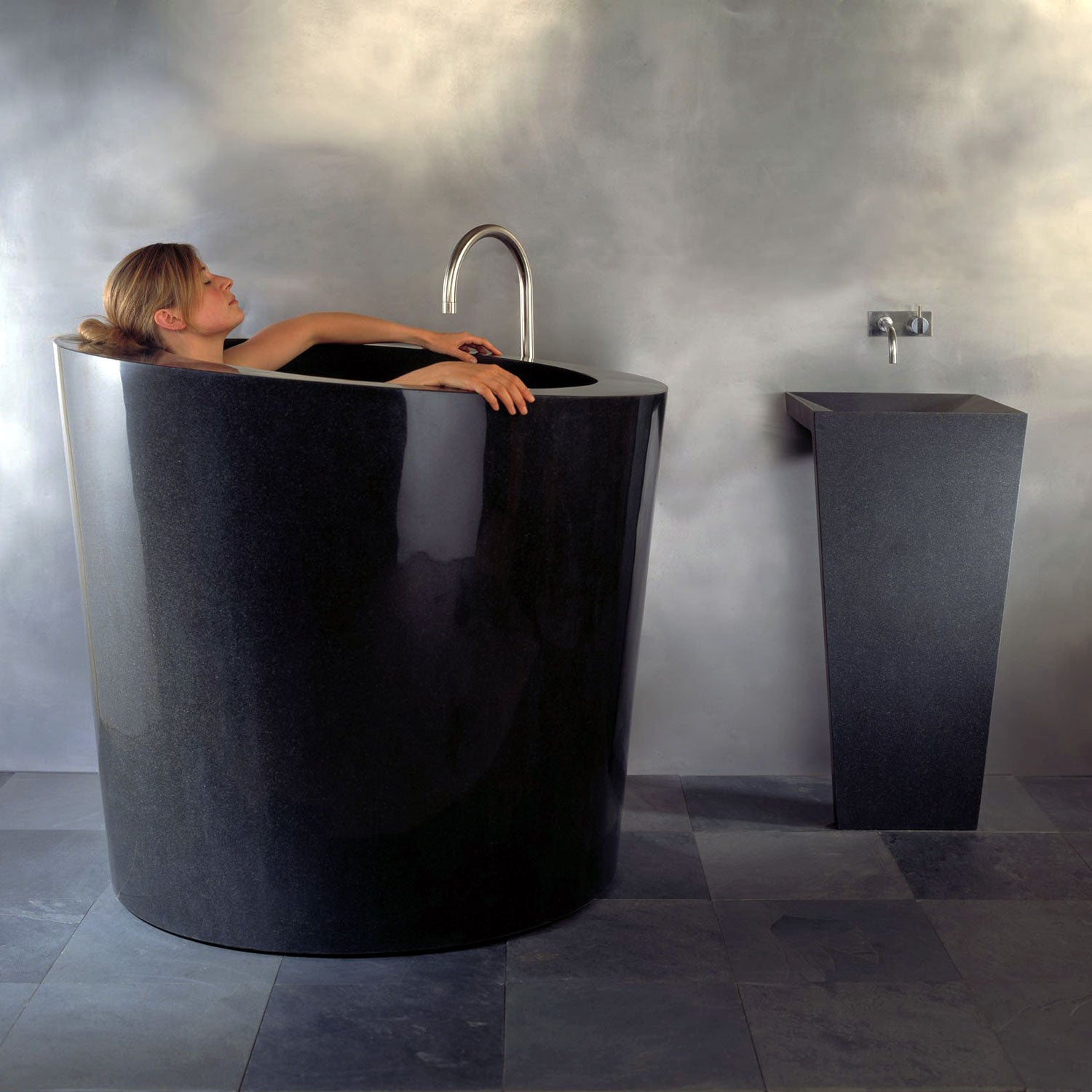
This massive, dark, dense, versatile material has gained widespread use throughout human history. Black granite can be carved in a variety of textures, from a rustic, rough-chiseled surface to a contemporary, high-polished one. For those who like the smooth finish of the polished, but want a matte look, the surface can be honed.
Because this material is born from molten magma and forms over hundreds of years, some natural mineral deposits are to be expected. These show up as round or irregular-shaped anomalies that are silver, gold or copper in color. These anomalies are generally small but can range up to approximately one inch in diameter (about the size of a quarter). These inclusions are a part of the makeup of the natural stone.
This stone is a good choice for custom designs
Fun Fact: Granite is the oldest igneous rock in the world, believed to have been formed as long as 300 million years ago. For those who’ve forgotten your high school science classes, igneous rocks are formed from cooling lava or magma.
This massive, dense, versatile material has gained widespread use throughout human history. Gray granite can be carved in a variety of textures, from a rustic, rough-chiseled surface to a contemporary, high-polished one. For those who like the smooth finish of the polished but want a matte look, this would be a honed finish (matte).
Because this material is born from molten magma and forms over hundreds of years, some natural mineral deposits are to be expected. These show up as round or irregular-shaped anomalies that are silver, gold or copper in color. These anomalies are generally small but can range up to approximately one inch in diameter (about the size of a quarter). These inclusions are a part of the makeup of the natural stone.
This stone is a good choice for custom designs.
Fun Fact: An igneous rock is a rock that solidified from molten rock. This is in comparison to the two other major types of rock, sedimentary and metamorphic.
Green Marble is used only for our Garden designs. See Pebble Fountains and Pebble Seats.
Marble is formed when limestone contains a lot of mineral calcite e.g. fossils. These various impurities have been mobilized and recrystallized by the intense pressure and heat of the metamorphism. The difference between limestone and marble lies in recrystallization. The content of other minerals in the rock defines the color of the marble. Green coloration is often due to serpentine resulting from
originally magnesium-rich limestone or dolomite with silica impurities.
We can only offer this material for garden items.
Jurassic is a sedimentary rock made of rounded pebbles and sand cemented together over hundreds maybe thousands of years by silica, calcite or iron oxide. The rock particles are rounded, formed in a high energy environment such as a beach or riverbed. The key characteristic is the visible, rounded clasts bound within a matrix. The clasts tend to feel smooth to the touch. This hard conglomerate rock is cut and polished to make dimension stone for our interesting-looking sinks and fountains.
We cannot offer this material for custom designs at this time.
FUN FACT: The presence of this Jurassic on Mars is compelling evidence that Mars once had flowing water: the pebbles in the rock are rounded, indicating they were transported along with a current and rubbed against one another. (Wind isn't strong enough to move pebbles this large.)
Multi-colored Onyx can range from pale green or ivory with very little veining or variation in color to something reminiscent of a wild abstract painting. This onyx is a layered stone in many gorgeous colors. The background colors are white, ivory or green. It is a quintessentially elegant stone with a combination of parallel banding and swirling veins in caramel, tan, brown and green.
It's the perfect material for those looking to add a stunning, natural accent to interior and exterior environments.
The crystalline structure and deep colors of onyx are hypnotizing, said Michael Zimber, founder and owner of Santa Fe, NM-based Stone Forest, who travels the globe in search of the best pieces of onyx for his solid stone sinks, bathtubs, and fountains. Every time we make a new carving out of the material were taken on a journey through layer after layer of geological history and Mother Nature's beauty.
Every one of our hand-carved, solid onyx creations is one-of-a-kind. Onyx is a highly variable material in terms of color, crystalline structure, and veining. The material not only varies significantly from block to block but within most individual blocks.
This stone is a good choice for custom designs.
Onyx fun facts: In Renaissance Europe, wearing onyx was believed to bestow eloquence.
Natural granite boulders are highly durable igneous rocks, with colors determined by their mineral content. The variety of colors is not visible until the natural crust is penetrated. The typical colors include brown, black, gray, and tan.
We begin with round, weathered granite boulders that have been shaped over millions of years through environmental exposure, resulting in softer forms. We carefully select fine- to medium-grained granite boulders that exhibit a consistent color for the carving process. The variations in size and color emphasize the material's natural origins.
Because this material is born from molten magma and forms over hundreds of years, some natural mineral deposits are to be expected. These show up as round or irregular-shaped anomalies that are silver, gold or copper in color. These anomalies are generally small but can range up to approximately one inch in diameter (about the size of a quarter). These inclusions are a part of the makeup of the natural stone.
Noce Basalt is a warmer tone than our Basalt material. It is an igneous (volcanic) material formed mostly from the rapid cooling of lava flows near the surface of our planet. Dense and durable, basalt lends itself to a wide range of sculptural applications.
In the kitchen and bath, we love basalt because it has the neutrality of dark concrete, coupled with the “radiant mass” of natural stone. In the garden, we use columnar basalt from a small, family-owned quarry in Inner Mongolia. These unusual columns are predominantly hexagonal in cross-section. We contrast the natural exterior that has weathered over thousands of years with polished facets that reveal the “soul” of the stone.
This stone is a good choice for custom kitchen & bath designs.
Please note: our basalt material has some non-structural inclusions that appear as thin white lines in the natural material. An example is shown on the second row first photo.